

You have to notice very low traffic or unexpectedly high traffic to your website recently; you are not the only one. The Google March 2026 Core Update has had a huge impact on the changes in the algorithm, especially in the fight against spammy things and low-value content.
This isn't simply a regular adjustment again. It is a major part of the general reevaluation of search engines to judge quality, trust, and usefulness as long as AI-generated content becomes more widespread.
In a nutshell, we’ll explain what has happened, what has changed, and how it impacts your website.
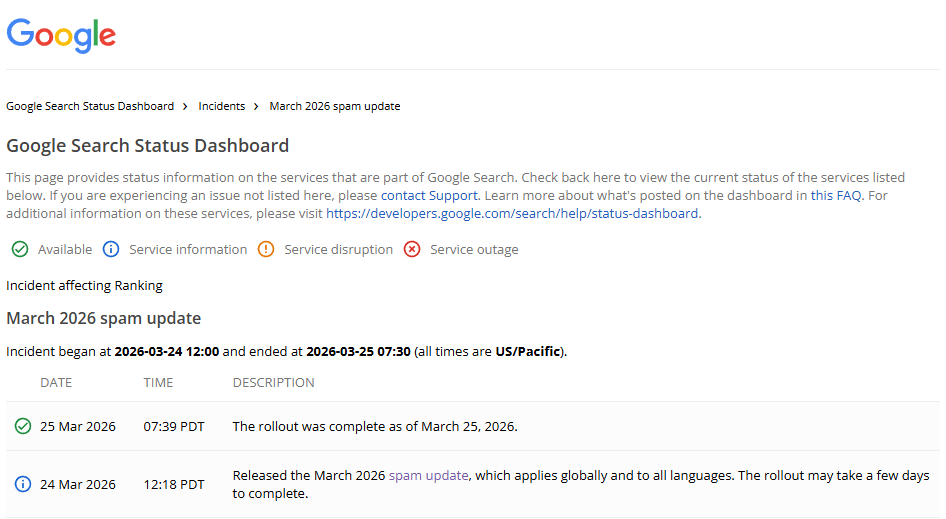
Here is the official statement by Google that verifies the March 2026 Spam Update at https://status.search.google.com/incidents/VbnSXAH4SmEcxPtx4YSD
What Changed in the March 2026 Core Update?
1. Smarter Spam Detection
Google has significantly improved its ability to detect patterns rather than just signals. Instead of flagging individual pages, it now evaluates the entire site's behavior.
This means:
- Sites with inconsistent quality are being downgraded
- Bulk AI-generated content without editorial oversight is getting hit
- Expired domains repurposed for SEO are losing visibility
2. Content Authenticity Signals
One of the biggest shifts is the importance of authenticity. Google is prioritizing:
- First-hand experience
- Unique insights
- Real expertise
Content that feels generic or stitched together from other sources is struggling, even if it’s technically “optimized.”
3. Site-Wide Quality Evaluation
This update reinforces something many SEOs have suspected: weak pages can drag down strong ones.
If a significant portion of your site is:
- Outdated
- Thin
- Irrelevant
…it can impact your entire domain’s rankings.
4. Link Spam Crackdown
Backlinks still matter, but not the way they used to before.
Google is now:
- Ignoring low-quality or irrelevant links entirely
- Penalizing manipulative link-building patterns
- Rewarding natural, contextually relevant mentions
Why This Update Matters
In the last few years, Google has had to deal with the problem of mass-produced, low-quality content on the internet, which is rapidly increasing.
Some of the new optimization tools have also started aligning themselves to this change. The focus is now shifting from the classic robots.txt-only setups to emphasizing the management of AI crawlers and large language models (LLMs) that access and interpret your content.
One of the new methods is the structured handling of directives that focus on AI, which can sometimes be called LLMs.txt, along with the traditional robots.txt. This helps site owners to signal the search engine about the content that should be prioritized, the content that should be ignored, and the content that should be contextualized for AI systems. A contextual inquiry is an important part of Speedboostr, which is redesigned to promote AI without prejudice to UI output.
Read more about it here:
https://speedboostr.io/boost-ai-visibility-seo-llms-txt-robots-txt-shopify.html
With AI tools making content creation faster than ever, the search ecosystem started seeing a spike in:
- Thin, repetitive articles
- Programmatically generated pages with little human value
- Sites built purely to manipulate rankings
Download the app here: https://apps.shopify.com/speed-optimization-webplanex
Who’s Being Hit the Hardest?
From early observations, the most affected sites include:
- Affiliate-heavy websites with minimal added value
- AI content farms publishing at scale
- Niche sites relying on outdated SEO tactics
- Websites with too much monetization and poor UX
On the bright side, sites that focus on authentic, original, and user-intended content are seeing growth.
The Role of AI Content in This Update
Let’s be clear, AI content itself isn’t the problem.
The issue is how it’s used.
Content that is:
- Mass-produced without editing
- Lacking human insight
- Created purely to rank
It is being filtered out and ranks lower than ever.
The lesson? AI should assist, not replace, thoughtful content creation.
Recovery: What You Should Do Now
If your site has been impacted, don’t panic, but act strategically with the following tips:
Audit Your Content
Identify:
- Thin or low-performing pages
- Duplicate or overlapping topics
- Outdated information
Improve or Remove
Not every page deserves to exist. Either:
- Upgrade it with real value
- Merge it with stronger content
- Or remove it entirely
Focus on Depth, Not Volume
Publishing more isn’t the answer anymore. Publishing better is.
Strengthen Topical Authority
Instead of covering everything, go deeper into your niche.
A Subtle but Important Shift: Crawling and AI Access
Although the majority of the individuals are occupied with the rankings, there is one more unobtrusive change that takes place in the background- the interaction of bots and AI systems with your site.
Search engines and AI crawlers are becoming increasingly picky. The management of access, crawl behavior, and resource allocation is becoming of critical importance.
A number of modern optimization tools have started to transform in accordance with the new reality. A case in point is that the latest methods already include the sophisticated management of bot access, and the latest format of robot directives is updated not only for regular search crawlers but also for new AI and LLM-based systems.
In platforms like Speedbnoostr, you might notice these changes reflected in how crawling rules and robot configurations are evolving. It’s less about blocking bots and more about guiding the right ones efficiently, ensuring your most valuable content gets discovered and processed correctly.
What This Means for the Future of SEO
The March 2026 update made one thing clear: SEO is no longer about gaming the system, it’s about aligning with it.
Going forward, success will depend on:
- Building real authority
- Creating helpful content
- Maintaining a clean, high-quality site structure
The margin for shortcuts is shrinking.
Final Thoughts
This shifting of course isn't a punishment; it was a necessary action that was almost mandatory to do.
If you still think of the old way of streaming, automating, or tactics that are no longer in use, it's time for you to upgrade your strategy.
Now that the Google update has come, the priority is not just quality, it is more than everything else.

